JapanSri Chinmoy Marathon Team

  • About us
  • Our races
  • Results

Search form

シュリチンモイ・マラソンチームはスポーツを通して自己超越を推進し、ランニングの愛好者に奉仕するという目的で1977年シュリチンモイによって設立されました。
read more »

シュリチンモイ・マラソンチーム

Articles & TV clips

History

From 2 to 3100 miles

Sri Chinmoy

シュリチンモイ

More events:

View all events »

Worldwide:

View full list »

Latest results:

19 November - Tokyo
2006年の記録
Details »

Previous races

View all results »

Worldwide results

Full list »

Gallery

By Anonymous
18 November

Click here to see all the albums (over 1300 photos from different parts of the world)...
 

Click here to see all the albums (over 1300 photos from different parts of the world)...

Cross-posted from

Sri Chinmoy Marathon Team articles - more articles

Article: How the joy of running came back to Takasumi Senoo

By Rupantar LaRusso author bio »
16 January

About the author:

Rupantar has been the race director of the Sri Chinmoy Marathon Team since 1985, having been asked by Sri Chinmoy to serve in that capacity. As well as working on the big races the US Marathon Team organise each year - the 3100 Mile Race and the Six and 10 Day Race - he also spends a considerable amount of time archiving the Marathon Team's 40 year history on this website.

In October, Takasumi Senoo became the first Japanese runner to complete the 3100 Mile Race, a feat that attracted considerable media attention in his native Japan. Mainichi Shimbun, the 3rd biggest national newspaper, published a very nice article titled Remarkable Achievement by Former Hakone Dropout: First Japanese to Complete 4989 km Ultramarathon. The title refers to ekiden, which is a relay style long distance run extremely popular in Japan. Hakone is considered the pinnacle race for university ekiden runners; it takes place on January 2 and 3 every year, right after the New Year’s Day, during the nation’s biggest holidays. The whole race is broadcast nationwide. Its prestige and popularity is discussed in detail in Adharanand Finn’s The Way of the Runner: A Journey into the Fabled World of Japanese Running.

This newspaper article came out shortly after this year’s Hakone Ekiden, surely a (nicely) tactful scheduling on Mainichi Shimbun’s part.


The world’s longest-level ultramarathon, which requires runners to complete approximately 4989 km within 52 days, just produced the first Japanese finisher. The distance is more than double the straight line between Sapporo (Hokkaido) and Naha (Okinawa) (2250 km), and is equivalent of running a full marathon (42.195 km) 118 times. The one who cemented his name in history is a former student-runner who once gave up running because he could not make it to Hakone Ekiden.

The race is called The Sri Chinmoy Self-Transcendence 3100 Mile Race, and took place in New York, USA, during September and October, 2021. At 6:50pm, October 26, Senoo Takasumi (38 years old) of Midori Ward, Yokohama City, smilingly broke through the finishing tape, holding aloft Japan’s national flag and the race flag. His time was 51 days, 12 hours, 50 minutes and 52 seconds. People at the finish gave him a great cheer, celebrating this 51st finisher in the race’s 25-year history.

He had always loved running since childhood. In autumn of his first year in junior high school, he joined the track and field club, and by his third year, he entered Kanagawa Marathon’s 5 km run open to all age groups, and made it to one of the top runners. He came to aspire to enter Kanagawa University, which won Hakone Ekiden twice in those days. He began envisioning himself in the Ekiden. With his satisfactory results in high school, he was successfully admitted upon recommendation, to one of Hakone Ekiden giants Tokai University.

The level of the prestigious team was beyond his imagination, however. He could run longer distances, but lacked speed. He realized that there was no way to compete with his teammates there; he was wanting the necessary talent. Only after 3 months, he left the team and also gave up running. He became an ‘ordinary student’ thereafter.

Across America ~ Turning Point
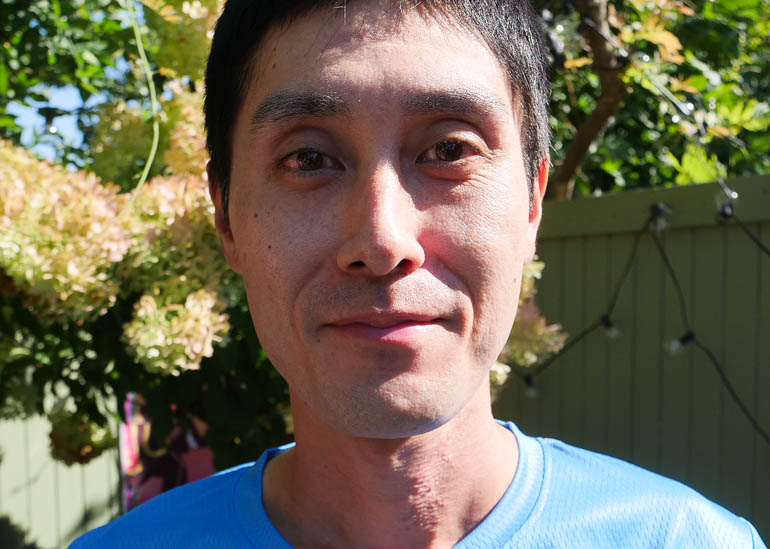
Team-Takasumi-1077121.jpgA year and a half after that, he one day thought: “I have gained some weight. Let me run again.” He put on his shoes that he had been unable to throw away, and began running in the neighborhood. The joy of running started coming back to him. “Yes, I left the team but that does not mean I should quit running.” Later, in his junior year in university in 2004, with the hope to overcome his setback, Senoo joined Run Across America (3080 miles = 4957 km), which turned out to be a big turning point for him. The huge sense of accomplishment after the finish prompted him to get deeply involved in long distance races.

While he participated in numerous races around the world, a new goal emerged: it is a race that started in 1997, named after the India-born philosopher and runner Sri Chinmoy (1931-2007). The race is invitation only, for those who have significant past achievements. Furthermore, out of all the world’s ultrarunners, only about 10 people can take part in it. Senoo actively entered various races, won in more than one of them, and for the first time got their invitation to be in the race.

For the Sri Chinmoy race, the cost amounts to about ¥1 million including the race fee, travel, and accommodation; there will be no prize money even after you complete the race. The race will last close to two months, so he made the decision to leave his work, the hospital he had worked for since he had registered as a nurse in 2013.

The runners of the race run around a high school in a suburb in New York City, about 883 meters of it, again and again. In order to finish, they need to run close to 100 km a day. They have to keep running in the same scenery, on hard concrete with inclines and declines. Because of his swelled feet, he had to cut the toe areas of his shoes, and in the end wore out 19 pairs.

To keep up with the high level of energy consumption, the runners are required to take about 10,000 kcal per day. In Senoo’s case, he managed by (sometimes) forcefully putting food, such as pie, into his mouth as he continued running. Every day from 6 am to midnight he ran, and went to bed at a nearby accommodation. The average hours of sleep was 4.5 hours. Once he was attacked by a severe headache and began vomiting. Finally, only short of 11 hours before the cutoff, he completed the race as the 5th finisher.

“Next Time, as Husband and Wife”

What supported him through all this was the presence of his wife, Yang Huang Lan (43 years old). They met as runners in 2019. Throughout this race, she assisted Senoo in handing out food etc.. He admits: “If I had tried on my own, I could not have completed it.” Toward the end of the race, he ran in ‘Mu’ (= Zen’s notion of nothingness).

The feeling of accomplishment this time exceeded that he had felt after the Run Across America. “I always remembered that feeling at age 21. And I kept running in quest of experiencing the same feeling once again. Now, finally, I have transcended it.” Hakone was a lost dream for young Senoo 20 years ago. Now, he has become the person who has run longer than anybody else in Japan.

And what is their new goal now? To run and complete the next Sri Chinmoy Race together.


  • By Makino Daisuke
  • Newspaper Name: Mainichi Shimbun, nationwide edition
  • Page, Date: p.23 (Society Section); January 6, 2022
  • Interviewed by: Yokohama Bureau of Mainichi Shimbun [Yokohama City in Kanagawa Prefecture is Takasumi’s hometown]

Translation from Japanese by Harashita Sunaoshi. As well as being an assistant to 3100 runner Harita Davies, she was also the liason for Japanese media; you can read about her experiences here...

View full article »

チェコのアベジャリさん、津軽海峡横断泳に成功。

By
10 November

2016年8月12日(金)、シュリ・チンモイ マラソンチーム メンバーでチェコ人のアベジャリ・ベルナドバさん(39)が津軽海峡横断泳に成功しました。横断泳の出発点である竜飛岬周辺は極寒の冬でも雪が積もらないほどの強風で知られ、また遭難したら遺体が上がらないほど潮の流れが強く変わりやすい海峡でもあります。このため津軽海峡はオーシャン・スイムを行う世界の強豪スイマーが制覇を目指す世界の7大海峡Ocean’s Sevenの一つに数えられています。

abhejali-2016-01.jpg

アベジャリさんはドーバー海峡横断泳を2011年に達成してから、厳しいトレーニングと瞑想を通し、ジブラルタル海峡(2013)、カタリーナ海峡(2015)と完泳を続け、津軽海峡は4海峡目の挑戦となりました。同海峡遠泳は夏の短い期間のみ行われ、一人当たりの割り当て日数が2日間しかないため、実力とともに天候や海のコンディションがその日に整っているかという運にも大きく左右されます。アベジャリさんが龍飛に到着したのは台風が去った直後、幸い波も静まり割り当て日の初日にスタートとなりました。

本州と北海道をつなぐこの海峡は最短で19.5kmほどですが、海流の関係で実際は30kmを泳ぐことになります。午後からのきつい潮の流れを避け、同時に真っ暗闇を泳ぐ時間を最短にするべく朝3時半に出発。水島船長さんの操縦する漁船に導かれ、船と平行に水中に流された白のノボリの真上を泳ぐことで正しい方向に泳ぎ続けます。オブザーバー(記録係)はオーシャンナビの東海林さん。ヘルプ・チームはアベジャリさんの妹ヤナさんとその婚約者のティアゴさん、シュリ・チンモイ マラソンチームからウジョギニ・ホールさん(オーストラリア)と私(砂押ホロシタ)です。

abhejali-2016-03.jpg

中盤強い潮に入り、1時間1キロというペースに落ちる困難に遭遇しながらも全体的には非常に穏やかな天候と波・潮に恵まれ、最後は目的地の中心に当たる灯台に無事到着しました。水島船長の長い経験でもこれまで他に3名しかこの中心点には到着できなかったということです。記録は11時間7分58秒。アベジャリさんは津軽海峡横断に成功した初のチェコ人となりました。当マラソンチームの創始者シュリ・チンモイの哲学「自分を超える(セルフ・トランセンデンス)」にのっとり、以後もオーシャンズ・セブンへの挑戦を続けています。(2017年10月現在、さらにハワイのモロカイ海峡とスコットランドーアイルランド海峡の2海峡を完泳し、残るはニュージーランドのみとなっています。) 

「私たちのモットーは
前進すること。
自分を超えていくことに
とてつもない喜びがある。」

Sri Chinmoy 〜シュリ・チンモイ

 
View full article »

Pradeep's interview on KBS Kyoto Radio

By Rupantar LaRusso author bio »
22 October

About the author:

Rupantar has been the race director of the Sri Chinmoy Marathon Team since 1985, having been asked by Sri Chinmoy to serve in that capacity. As well as working on the big races the US Marathon Team organise each year - the 3100 Mile Race and the Six and 10 Day Race - he also spends a considerable amount of time archiving the Marathon Team's 40 year history on this website.
Pradeep.jpg
Pradeep during the 2012 race

Pradeep Hoogakker, a member of the Sri Chinmoy Marathon Team and a 2011 Sri Chinmoy Self-Transcendence 3,100-Mile Race finisher, was interviewed on KBS Kyoto Radio, Japan on October 22.

The 10 minute program has been aired for 15 years, and is the first of its kind in Japan specifically dedicated to lay runners.

The runner-radio host Ms. Junko Wakabayashi (aka Waka), a well-known figure in the running world, dedicated the whole program for this interview. 

Transcript of interview (English translation):

Waka:I interviewed Mr. Pradeep Hoogakker from the Netherlands, who completed this race in 53 days and 9 hours in 2011. About the race:

  • Started by Sri Chinmoy Marathon Team in New York in 1997, continuing for 20 years.
  • 3100 miles = 4989km (approximately 5000km)
  • Race Track: 5649 laps of a 880m-long loop
  • Cut-off: 52 days (To complete, the runner has to run at the pace of 95.9km per day.)
  • Note: In the year Mr. Pradeep did the race, the cut-off was extended to 54 days due to the extreme heat.
  • 39 runners completed in the 20 years
  • The race track was open every day from 7am to 12 midnight.
  • 7000 to 10000kcal must be consumed each day, equivalent of one week’s food intake for a person with normal activities.
  • The kitchen crew cooks customized food for each runner.
  • The runners use up 10 to 12 pairs of shoes.
  • Average temperature: 30C, Humidity: 80-95%

Waka: What brought you to the race?

Pradeep: One day, while I was meditating after having a good run, the idea of running the 3100 mile race spontaneously came to my heart and I felt an inner thrill. I had been to the race a few times as a helper before. I got advice from the runners then, and trained myself for 6 years. I trained to run long distances, starting from 10km a day, 40km once a week, and up to 100km once a month. I also practised how to eat while running, as well as trying different running outfits and shoes.

Waka: And the actual race came. Didn’t you get bored running 5649 laps?

Pradeep: Everybody asks that question! Actually, many ultra races have loops instead of a straight route. It actually makes a lot of sense since you can have your own table where you can put your belongings such as shoes and supplements. Also, you feel everybody is running together—from the fastest to the slowest ones in the race. We can inspire each other, and we feel oneness, which is really good.

Waka: Still, it’s sooo long. How did you keep your motivation?

Pradeep: We told different jokes to each other!

Waka: What was most difficult?

Pradeep: The first 10 days were really difficult. My feet were not used to running on concrete; at night, my whole body ached and could not sleep. My mind started thinking, “How can I run tomorrow being like this?,” which made me sleepless. But as weeks went by, I learned that I could run even if I had not been able to sleep the night before. Something within myself recovered with renewed energy.

Waka: What was most moving?

Pradeep: There were many things. I felt oneness, and one morning, as I watched the sun rise, I felt as if the sun was rising inside my own heart. And I felt: This is life…!

Waka: You experienced Life…yet, your feet must have been…?

Pradeep: All blisters! Can I say something gross?

Waka: No thank you! Did you discover something new about yourself?

Pradeep: I realized I had a tendency to feel sorry for myself. So I had to conquer that. I could not complete the race unless I could truly feel I could do it. The process of overcoming my weaknesses became a valuable experience.

Waka: Has your life perspective changed after the race?

Pradeep: Yes. The wonderful experiences during the race stay inside myself even after the race finished. I feel that happiness means progress; going forward. In ordinary life, many times we think we are going forward but are actually going round and round in the same place. But in this race, though we were running round and round, I felt I was going forward. Those are what I learned through the race. My weaknesses unavoidably came forward so I had no choice but to conquer them, which led to joy and happiness.

Waka: What is your goal now?

Pradeep: There are many. Everybody needs a new goal. My first aim is to improve my marathon time, from 3 hours 4 minutes to under 3 hours. I also want to write a book about my 3100 race experiences. Most importantly, I feel Sri Chinmoy’s philosophy “Self-Transcendence” is wonderful. No matter what field you are in, the important thing is to transcend yourself.

Waka: You have said so much today that resonate with our souls: ‘Continuous self-transcendence,’ ‘Importance of feeling inner thrill in your heart’, and ‘Happiness means progress’.

Dear listeners, are you doing something that thrills your heart? Are you trying to transcend yourself now? Yes, you can start today! I was so moved to meet Mr. Pradeep. Thank you so much!

  • Transcript of interview on KBS radio (Japanese)...
  • 3100 Mile race website...
View full article »

Swimming Tsugaru Strait: Abhejali achieves her 4th 'Oceans Seven'

By Vasanti Niemz
13 August
  • almost there - Abhejali swimming Tsugaru Strait
  • on the boat before the start
  • swimming into the dawn
  • ideal and actual route
  • successful and happy

Prayers, focus, visualisation and serious preparation nicely worked together! After the strong wind conditions caused by a typhoon blew out any chances for swimmers only few days earlier, Abhejali Bernardova (39) of our Czech Sri Chinmoy Marathon Team had almost perfect conditions for her attempt to cross the Tsugaru Channel between Honshu and Hokkaido in northern Japan, which is about 19.5 km wide at its narrowest point.

In the early morning of Friday, Aug. 12, 2016, at 3.30 am, shortly before sunrise, the accomplished English Channel swimmer and "Triple Crowner" (EC, Manhattan Island and Catalina Channel) stepped into the unusually warm (23°C) waters of the strait on the shores of Tappi Misaki, taking advantage of the calm after the storm, to tackle the 30km distance. As you can see on the map, Tappi Misaki is not the closest point to the other shore, but experience shows it is one of the best points to start a swim factoring in the currents constantly pushing from the west through the straits.

Expertly guided by captain Mizushima of the Tsugaru Channel Swimming Association, who uses a white underwater "streamer" to help the swimmer stay on course, and supported by a great team with observer Mika Tokairin from Tokyo, sister Jana Bernadova from London, sister`s fiancé Tiago, and good friends Uddyogini Hall from Australia and Harashita of the Sri Chinmoy Marathon Team Japan, Abhejali experienced one of the calmest swim days of the year. Her helpers texted: "There were only tiny waves and almost no wind. In the middle she was visibly slowed down by the strong current passing through the strait, but she managed to stay west of the perfect line, which was ideal to avoid any tricky currents at the end." She had a perfect finish at the foot of the lighthouse in a time of 11 hours 07 min 58 sec. According to the captain, only some 3 swimmers or so have managed to land right at the lighthouse before.

Abhejali is the first Czech swimmer to successfully cross the Tsugaru Channel. Having completed 4 Oceans Seven solo swims now (the "classic way" without wetsuit!) - English Channel (2011), Gibraltar Strait (2013), Catalina Channel (2015) and Tsugaru Strait (2016) - she is already planning her next big swim adventure. Abhejali is inspired on the one hand by the challenge of the "Oceans Seven" launched by Open Water visionary Steven Munatones, as well as by the philosophy of self-transcendence of her late meditation-teacher Sri Chinmoy, founder of the international Sri Chinmoy Marathon team, who is known for his pioneering inner approach to athletic endurance feats in running, swimming and beyond.

 "Our philosophy
Is progress.
 In our self-transcendence
Is our tremendous joy."

Sri Chinmoy

View full article »

Climbing Mount Fuji for peace

By Nirbhasa Magee author bio »
1 April

About the author:

Nirbhasa is from Ireland. He is an enthusiastic multi-day runner, having completed four times the Sri Chinmoy Self-Transcendence 3100 Mile Race - the longest race in the world.

fuji2.jpg

As part of a project founded by Sri Chinmoy to dedicate countries, cities and natural landmarks in the name of peace, 20 mountains from all over the world were dedicated as 'Sri Chinmoy Peace-Blossom Mountains'. Asprihanal Aalto from Finland (world record holder for the 3100 Mile Race) and Vaibhava Kuschnow from Vienna, Austria have embarked on a project to scale them all. Here are Vaibhava's notes from a recent trip to Mount Fuji:

The captain just announced our descent to Tokyo Narita, and I am looking forward to finally stepping out of the plane where Akanda will (hopefully) pick me up. I feel excitement and am very curious about coming to Japan for the first time. I am also looking forward to meeting Ashprihanal and wonder what sort of experiences Japan’s highest mountain has prepared for us. Mt Fuji (3776m) is one of about 20 Sri Chinmoy Peace-Blossom Mountains spread all over the world. Being climbers looking for a challenge, Ashprihanal and myself have decided to climb all of them – if so is God’s Will.

Over 300,000 people climb Mt Fuji between June and September, and less then 100 during the rest of the year. This is for a good reason – in the winter months the winds exceed 100km/h on a regular basis and temperatures can easily drop below -25C, which will feel something like -45C in the wind. However, we also have Mt Logan in Canada and Denali (Mt McKinley) in Alaska on our list to climb this year, so we want to be prepared – climbing Fuji in winter seemed to be a great opportunity to test all our gear in “real-world-conditions” while being able to retreat quickly if necessity demanded AND to lop one more mountain off our list AND to visit JAPAN! So I am looking forward to new adventures.

Akanda picked me up from Narita and we drove to Tokyo to meet with everyone else to continue our trip to the foot of Mt Fuji where we stayed in a traditional Japanese house – a Ryokan – with tatami floor, low tables and a hot tub – all embedded in a beautiful forest. We were filming, checking our gear, eating, hanging out in the hot tub and just had a great evening together.

fuji3.jpg

The next day, we drove to the 4th station on the north face of Fuji at 2020m and headed for the woods straight up. Our backpacks weighed around 20 kg and contained a tent, sleeping bags, mattresses, stoves, warm clothes, down pants and jackets, waterproofs, crampons, ice axes, a shovel, food and so on and so on... We started out around noon in fog and drizzling rain and as we left the forest the wind picked up. One problem we ran into was the diffiulty to find a place for the tent: the mountain is constantly sloping and we were very grateful to find a small spot with deep snow under some bushes by the end of the day.

Being in the mountains in winter is pretty basic: set up shelter, melt snow for food, dry wet things on your body (because this is the only source of heat you have out there) meditate and enjoy the view or hide from the storms (it depends...). We had some heavy snowfall and enjoyed our sleeping bags. Next morning we had side wind with wet snow, which makes staying warm and dry a challenge in spite of Goretex. Around noon the wind ebbed and the snow stopped and after cooking some ramen between rocks on sloping snow we drew new hope and made it to the top in the late afternoon. 

fuji1.jpg

We slept inside the crater and just made it back in time to catch the sunrise. We had a perfect blue sky, it was pretty warm (-7C) but windy and we meditated and enjoyed the scenery for a while before sliding down approximately 800 m on a snow slope. We made it down to the 4th station by noon and tried to catch a bus to Tokyo – which was not very easy considering that my knowledge of Japanese was limited to only one word, namely: arigato (thank you!) and the fact that their English was not much better.

To make a long story short: of course we somehow made it and spent a few wonderful days in the Land of the Rising Sun, visiting Tokyo, Kyoto, Ise and Kamakura, meeting people as well as different temples and last but not least the Great Buddha, which I was very very very very impressed with. We had problems getting vegetarian food, but loved the Shinkansen and we never ceased to be amazed by the kindness, politeness and helpfulness of Japanese people. Their helpfulness made up for all our incapacities and will remain the strongest impression I take back home, along with the overwhelming peace of the Great Buddha and the blue sky on top of Mt Fuji.

View full article »
More articles under Sri Chinmoy Marathon Team articles »

more »

Sri Chinmoy Marathon Team articles

main page »

Stories from around the world

United Kingdom
SRI CHINMOY 5K - Scottish Championship 2026
Worldwide
First Sub-Two Hour Marathon
United States
3, 6 and 10 Day Race 2026 Results
New Zealand
28th Sri Chinmoy 6-12-24 Hour Track Races - AUT Millennium Stadium, Auckland
Worldwide
Swimming for Peace
3100 Mile Race
Highlights of 3100 Mile Race 2025
Channel & Open Water Swimming
Swimming 20 Bridges around Manhattan for Peace

About us

  • About the Marathon Team
  • Sri Chinmoy, Team Founder

Our races

  • View all events

Results

  • Previous races
  • Worldwide results
Global homepage »

Country Websites

  • W.Europe
    • Austria
    • Finland
    • France
    • Germany
    • Great Britain
    • Iceland
    • Ireland
    • Italy
    • Netherlands
    • Norway
    • Portugal
    • Switzerland
  • Central & E. Europe
    • Belarus
    • Bulgaria
    • Croatia
    • Czech Republic
    • Hungary
    • Latvia
    • Macedonia
    • Moldova
    • Russia
    • Serbia
    • Slovenia
    • Slovakia
    • Ukraine
  • N. & S. America
    • Brazil
    • Canada
    • Guatemala
    • United States
  • Asia
    • Japan
    • Mongolia
  • Oceania
    • Australia
    • New Zealand

Other sites

  • Sri Chinmoy Cycling Team
  • SCMT Channel Swimming
  • SCMT Climbing
  • 3100 Mile Race

Popular Pages

  • 3100 Mile Race
  • Recent media coverage
  • History 1977-Present
  • Our members
  • Cookie settings
  • Log in

Contact Information

Sri Chinmoy Marathon Team
Creative Commons License

Except where explicitly stated otherwise, the contents of this site are licensed under a Creative Commons Attribution-NonCommercial-NoDerivs 3.0 Unported License read more »

SriChinmoyRaces.org is a Vasudeva Server project.